INSULIN- Pharmacology drug monograph
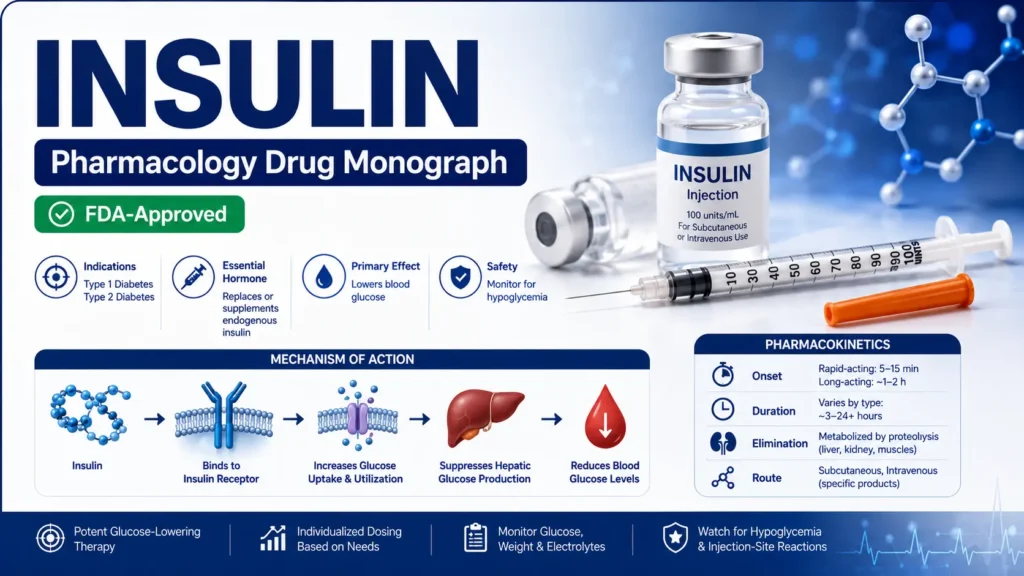
Current insulin pharmacology guide covering types, FDA-approved uses, mechanism, pharmacokinetics, dosing principles, adverse effects, interactions, monitoring and safety.
What Is Insulin?
Insulin is a peptide hormone produced by pancreatic β-cells and a major therapeutic drug for diabetes mellitus. Pharmaceutical insulin preparations replace or supplement endogenous insulin and are essential for people with type 1 diabetes and frequently used in type 2 diabetes when additional glucose-lowering therapy is required. FDA-approved insulin products include human insulin and insulin analogs with different onset and duration profiles.
Unlike oral antidiabetic drugs, insulin directly replaces the hormone responsible for glucose uptake, storage and metabolic regulation. Because insulin preparations differ substantially in pharmacokinetics, there is no single universal insulin dose.
Insulin Quick Facts
| Property | Information |
|---|---|
| Drug class | Peptide hormone / antihyperglycemic |
| Main therapeutic role | Insulin replacement or supplementation |
| Major indications | Type 1 and type 2 diabetes |
| Route | Mainly subcutaneous; some products/routes allow IV administration |
| Major types | Rapid-, short-, intermediate-, long-acting and premixed |
| Main target | Insulin receptor |
| Main effect | ↓ Blood glucose |
| Major adverse effect | Hypoglycemia |
| Other important effects | Weight gain, hypokalemia, edema, injection-site reactions |
| Dose | Individualized according to insulin type and clinical needs |
FDA-Approved Uses
Individual insulin products are FDA-approved to improve glycemic control in patients with diabetes mellitus, although the exact age range, route and formulation vary by product. For example, insulin lispro is indicated for adults and pediatric patients with diabetes, while insulin glargine products are approved for glycemic control in adults and pediatric patients with diabetes.
Regulatory classification
| Use | Status |
|---|---|
| Type 1 diabetes | FDA-approved for appropriate insulin products |
| Type 2 diabetes | FDA-approved for appropriate insulin products |
| Diabetic ketoacidosis | Specific IV insulin products/regimens are used; product labeling must be followed |
| Hyperkalemia | Common clinical use but generally off-label |
| Athletic/performance enhancement | Not an approved therapeutic use |
| Anti-aging/longevity | Investigational/not FDA-approved |
| Oral insulin for routine diabetes treatment | Investigational/not a standard FDA-approved insulin route |
Types of Insulin
Insulin preparations are commonly classified according to their time-action profile:
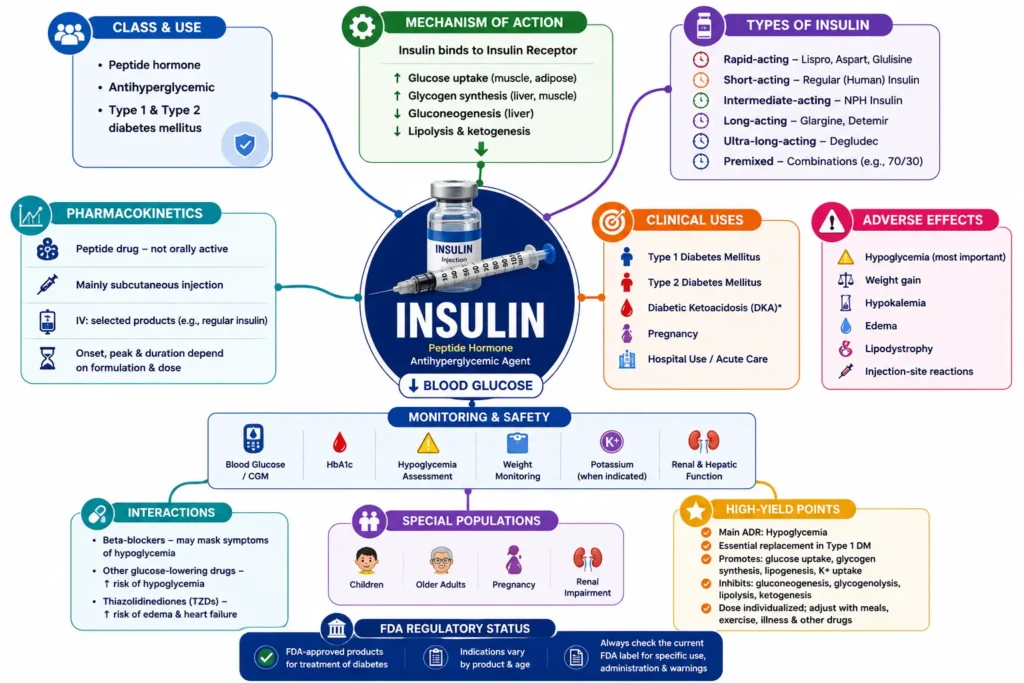
- Rapid-acting: insulin lispro, insulin aspart, insulin glulisine
- Short-acting: regular human insulin
- Intermediate-acting: NPH insulin
- Long-acting: insulin glargine, insulin detemir
- Ultra-long-acting: insulin degludec
- Premixed: combinations of prandial and intermediate-acting insulin
The FDA also recognizes inhaled insulin among approved insulin products.
Mechanism of Action
Insulin binds to the insulin receptor, a receptor tyrosine kinase, initiating intracellular signaling pathways including the IRS–PI3K–Akt pathway.
Its major metabolic actions are:
Insulin → insulin receptor activation → ↑ glucose uptake + ↑ glucose storage → ↓ blood glucose
Insulin:
- Increases glucose uptake in skeletal muscle and adipose tissue
- Stimulates glycogen synthesis
- Inhibits hepatic gluconeogenesis and glycogenolysis
- Promotes lipid and protein synthesis
- Suppresses lipolysis and ketogenesis
- Drives potassium into cells
Pharmacodynamics
Insulin produces glucose-lowering effects that vary according to formulation, dose, injection site and individual patient characteristics. Rapid-acting analogs are designed primarily for mealtime glucose control, whereas basal preparations provide prolonged insulin activity between meals and overnight. Modern analogs can provide more predictable time-action profiles than conventional preparations.
Pharmacokinetics
Insulin is a peptide and therefore is generally administered by injection rather than swallowed orally.
Its pharmacokinetics depend strongly on formulation:
| Type | Main clinical role |
|---|---|
| Rapid-acting | Mealtime/postprandial control |
| Regular | Mealtime control; IV use for selected products |
| NPH | Intermediate basal coverage |
| Long-acting | Basal glucose control |
| Ultra-long-acting | Extended basal coverage |
For example, insulin lispro may be administered shortly before or immediately after a meal according to its labeling, while insulin glargine is administered once daily at approximately the same time each day.
Dosage and Administration
Insulin dosage must be individualized according to:
- Type of diabetes
- Insulin formulation
- Blood glucose and HbA1c
- Meal pattern
- Physical activity
- Renal/hepatic function
- Previous insulin exposure
Because formulations and concentrations differ, patients should not independently substitute one insulin product for another. Changes in insulin type, strength, manufacturer or administration method require careful supervision and increased glucose monitoring.
Adverse Effects
The most important adverse effect is hypoglycemia, which can be severe or life-threatening.
Other adverse effects include:
- Weight gain
- Hypokalemia
- Edema
- Injection-site reactions
- Lipodystrophy
- Localized cutaneous amyloidosis
- Allergic or hypersensitivity reactions
These reactions are documented in current insulin prescribing information.
Contraindications and Interactions
Insulin products are generally contraindicated during hypoglycemia and in patients with serious hypersensitivity to the specific product or its excipients.
Important interacting medicines include drugs that alter glucose metabolism. Beta-blockers can reduce recognition of some hypoglycemia symptoms, while other glucose-lowering drugs may increase hypoglycemia risk. Thiazolidinediones used with insulin may increase fluid retention and heart-failure risk.
Monitoring
Patients receiving insulin require monitoring of:
- Blood glucose
- HbA1c
- Hypoglycemia
- Injection sites
- Body weight
- Potassium when clinically indicated
- Renal and hepatic function when appropriate
Continuous glucose monitoring can also support individualized insulin adjustment.
Special Populations
Children: Many insulin products are approved for pediatric diabetes, but age indications vary by product.
Older adults: Treatment should account for hypoglycemia risk, comorbidities and renal function.
Pregnancy: Insulin is an established treatment option for diabetes during pregnancy; product-specific labeling and clinical guidelines should guide selection.
Renal impairment: Reduced insulin clearance may increase hypoglycemia risk and may require dose adjustment.
Clinical Evidence
Insulin remains the most potent glucose-lowering therapy and is indispensable for type 1 diabetes. In type 2 diabetes, progressive β-cell dysfunction can eventually make insulin necessary for achieving glycemic targets. Evidence also shows that basal and newer insulin analogs can provide effective glycemic control, with some long-acting analogs associated with less nocturnal hypoglycemia than NPH insulin.
High-Yield Student Points
- Target: Insulin receptor
- Main effect: ↓ Blood glucose
- Rapid acting: Mealtime control
- Long acting: Basal control
- Most important ADR: Hypoglycemia
- Other key ADRs: Weight gain and hypokalemia
- Insulin promotes: Glucose uptake, glycogen synthesis and potassium uptake
- Insulin inhibits: Gluconeogenesis, glycogenolysis, lipolysis and ketogenesis
- Type 1 diabetes: Essential replacement therapy
FAQs
What is the main mechanism of insulin?
Insulin activates the insulin receptor and promotes glucose uptake and storage while suppressing hepatic glucose production.
What is the most serious adverse effect?
Hypoglycemia is the major potentially life-threatening adverse effect.
What are the main types of insulin?
Rapid-, short-, intermediate-, long- and ultra-long-acting preparations, plus premixed formulations.
Is insulin FDA-approved for type 2 diabetes?
Yes. Multiple insulin products are FDA-approved to improve glycemic control in adults and/or children with diabetes, depending on the specific product.
Related Drugs
- Metformin
- Sulfonylureas
- SGLT2 inhibitors
- DPP-4 inhibitors
- GLP-1 receptor agonists
- Tirzepatide
- Thiazolidinediones
- Meglitinides