Pharmacokinetics: ADME, Definition, Principles & Examples
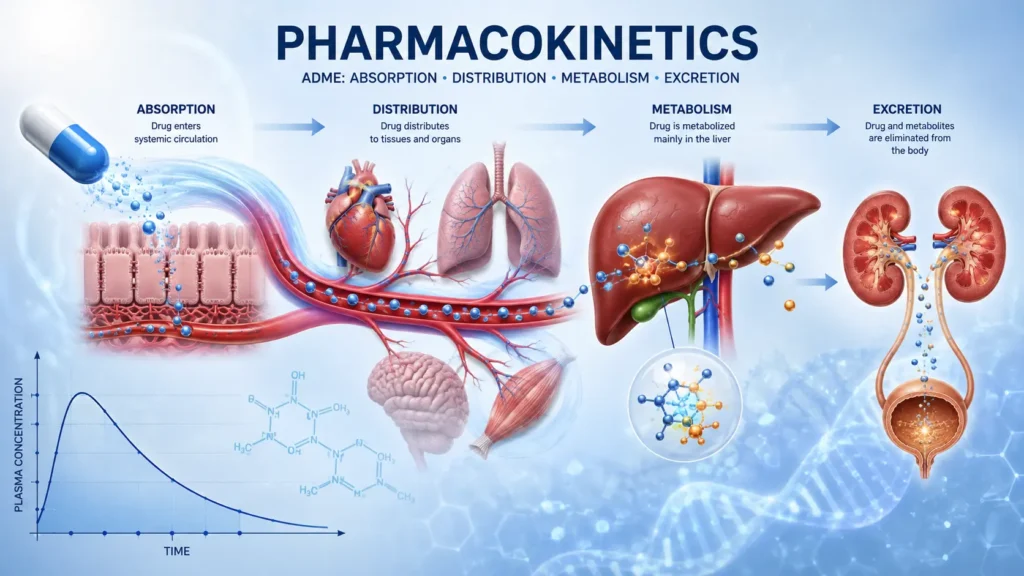
Learn pharmacokinetics, including ADME, drug absorption, distribution, metabolism, excretion, bioavailability, clearance, half-life, Vd, AUC and clinical applications.
Pharmacokinetics is one of the fundamental areas of pharmacology that explains what the body does to a drug after administration. It describes how a drug is absorbed, distributed, metabolized, and eliminated from the body. These four processes are commonly summarized as ADME: Absorption, Distribution, Metabolism, and Excretion.
Understanding pharmacokinetics is essential for determining appropriate drug doses, dosing intervals, routes of administration, therapeutic drug monitoring, and individualized drug therapy. Pharmacokinetic principles are also important in drug discovery, pharmaceutical development, clinical trials, and regulatory evaluation.
In simple terms:
Pharmacokinetics describes how the concentration of a drug changes in the body over time.
Table of Contents
- What Is Pharmacokinetics?
- Pharmacokinetics Definition
- Pharmacokinetics vs Pharmacodynamics
- What Does ADME Mean?
- Absorption
- Factors Affecting Drug Absorption
- Bioavailability
- First-Pass Metabolism
- Distribution
- Volume of Distribution
- Plasma Protein Binding
- Blood-Brain Barrier
- Drug Metabolism
- Phase I Drug Metabolism
- Phase II Drug Metabolism
- Cytochrome P450 Enzymes
- Drug Excretion
- Renal Drug Excretion
- Important Pharmacokinetic Parameters
- Clearance
- Half-Life
- Elimination Rate Constant
- Area Under the Curve
- Cmax and Tmax
- Steady State
- First-Order Kinetics
- Zero-Order Kinetics
- Pharmacokinetic Examples
- Clinical Importance of Pharmacokinetics
- Factors That Affect Pharmacokinetics
- Pharmacokinetics in Drug Development
- Pharmacokinetics and Therapeutic Drug Monitoring
- Key Takeaways
- Frequently Asked Questions
What Is Pharmacokinetics?
Pharmacokinetics is the study of the time course of drug concentrations in the body and the processes responsible for changes in those concentrations.
The major pharmacokinetic processes are:
- Absorption – movement of a drug into systemic circulation
- Distribution – movement of a drug between blood and tissues
- Metabolism – chemical transformation of the drug, often in the liver
- Excretion – removal of the drug and/or metabolites from the body
Together, these processes are known as ADME.
Pharmacokinetic studies help researchers and clinicians understand drug exposure, determine dosing regimens, evaluate drug interactions, and adjust therapy when patient characteristics affect drug disposition.
Related article: [Internal Link: What Is Pharmacodynamics?]
Pharmacokinetics Definition
Pharmacokinetics Definition in Simple Terms
Pharmacokinetics is the study of what the body does to a drug.
It describes:
- How quickly a drug enters the bloodstream
- How widely it distributes throughout the body
- How the body chemically modifies it
- How quickly it is removed
- How drug concentrations change with time
Pharmacokinetics is therefore closely associated with drug concentration, exposure, dose, time, and elimination.
Pharmacokinetics vs Pharmacodynamics
Pharmacokinetics and pharmacodynamics are related but describe different aspects of drug action.
| Pharmacokinetics | Pharmacodynamics |
|---|---|
| What the body does to the drug | What the drug does to the body |
| Includes ADME | Includes drug effects and mechanisms |
| Focuses on drug concentration over time | Focuses on concentration-effect relationships |
| Determines drug exposure | Helps explain therapeutic and adverse effects |
| Includes clearance and half-life | Includes receptors, potency and efficacy |
Example
If a patient takes a tablet:
Pharmacokinetics asks:
How much drug reaches the blood, where does it go, how is it metabolized, and how is it eliminated?
Pharmacodynamics asks:
What effect does the drug produce after reaching its target?
Related article: [Internal Link: Pharmacodynamics: Definition, Mechanism, Receptors, Potency & Efficacy]
What Does ADME Mean?
ADME stands for:
A — Absorption
The process by which a drug moves from its administration site into systemic circulation.
D — Distribution
The reversible movement of drug between the bloodstream and body tissues.
M — Metabolism
The enzymatic modification or transformation of a drug, often producing metabolites.
E — Excretion
The removal of drug and/or metabolites from the body.
ADME is a standard framework for understanding drug disposition and is widely used in pharmacology, pharmaceutical research, drug development, and clinical pharmacology.
1. Drug Absorption
Drug absorption is the movement of an administered drug from its site of administration into the systemic circulation.
For example, after an oral tablet is swallowed, the drug must dissolve, pass through biological membranes, and reach the bloodstream before it can produce systemic effects.
Absorption is therefore particularly important for drugs administered by routes such as:
- Oral
- Intramuscular
- Subcutaneous
- Transdermal
- Rectal
- Nasal
- Inhalational
Intravenous administration is different because the drug is delivered directly into systemic circulation and does not require an absorption step in the conventional sense.
Mechanisms of Drug Absorption
Drugs can cross biological membranes through several mechanisms.
Passive Diffusion
Many drugs cross membranes by passive diffusion from an area of higher concentration to an area of lower concentration.
The process generally does not require cellular energy.
Facilitated Diffusion
A carrier protein assists drug movement across a membrane without directly requiring metabolic energy.
Active Transport
Active transport involves carrier proteins and can move substances against a concentration gradient.
Endocytosis
Some large molecules may enter cells through vesicle-mediated processes.
The mechanism of absorption depends on drug properties, formulation, membrane characteristics, and physiological conditions.
Factors Affecting Drug Absorption
Several factors can influence how much and how quickly a drug is absorbed.
Important factors include:
- Drug solubility
- Lipid solubility
- Particle size
- Dosage form
- Gastric emptying
- Intestinal motility
- Gastrointestinal pH
- Food
- Drug interactions
- Blood flow
- Membrane permeability
- Route of administration
- Stability of the drug in the gastrointestinal tract
For orally administered drugs, gastrointestinal physiology can have a major influence on absorption.
Related article: [Internal Link: Drug Absorption: Mechanisms, Factors & Examples]
2. Bioavailability
Bioavailability (F) refers to the fraction of an administered dose that reaches systemic circulation in an available form.
For an intravenous dose, bioavailability is generally considered to be 100%, assuming complete systemic delivery.
For many orally administered drugs, bioavailability can be lower because of incomplete absorption and presystemic elimination.
Absolute Bioavailability Formula
For comparing an extravascular route with intravenous administration:
F = (AUCₑᵥ / Doseₑᵥ) ÷ (AUCᵢᵥ / Doseᵢᵥ)
Where:
- F = absolute bioavailability
- AUC = area under the plasma concentration-time curve
- Doseₑᵥ = extravascular dose
- Doseᵢᵥ = intravenous dose
Bioavailability studies are important in pharmaceutical development and regulatory evaluation. The FDA provides specific guidance regarding bioavailability studies for drug products.
Calculator: [Internal Link: Bioavailability Calculator]
3. First-Pass Metabolism
First-pass metabolism refers to presystemic metabolism that occurs before an orally administered drug reaches systemic circulation.
The gastrointestinal tract and liver can contribute to presystemic elimination.
As a result, only a portion of the administered dose may reach systemic circulation unchanged.
Example
Suppose a drug has an oral dose of 100 mg but its systemic bioavailability is 50%.
Approximately:
Systemically available dose = 100 mg × 0.50 = 50 mg
The remaining amount does not necessarily represent a single process; it may reflect incomplete absorption and presystemic metabolism or other losses.
Related article: [Internal Link: First-Pass Metabolism: Definition, Mechanism & Examples]
4. Drug Distribution
After entering systemic circulation, a drug can distribute between blood and tissues.
Distribution depends on factors such as:
- Blood flow
- Tissue perfusion
- Lipid solubility
- Plasma protein binding
- Tissue binding
- Capillary permeability
- Molecular size
- Physiological barriers
- Tissue composition
Highly perfused organs such as the liver, kidneys, heart, and brain can receive drugs relatively rapidly, although the extent of penetration varies among drugs and tissues.
5. Volume of Distribution
The volume of distribution (Vd) is a pharmacokinetic parameter that relates the amount of drug in the body to the measured plasma concentration.
Formula
Vd = Amount of drug in the body / Plasma drug concentration
For a simple intravenous bolus model:
Vd ≈ Dose / C₀
Where:
- Vd = volume of distribution
- Dose = administered dose
- C₀ = extrapolated initial plasma concentration
Vd is an apparent volume, not necessarily an actual anatomical volume.
A high Vd generally indicates that a relatively large proportion of drug is outside the plasma compartment.
Example
Suppose:
- Dose = 500 mg
- Plasma concentration = 10 mg/L
Then:
Vd = 500 mg / 10 mg/L
Vd = 50 L
Calculator: [Internal Link: Volume of Distribution Calculator]
6. Plasma Protein Binding
Many drugs reversibly bind to plasma proteins such as:
- Albumin
- α₁-acid glycoprotein
Only the unbound fraction is generally available to diffuse into tissues and interact with targets, although the relationship between protein binding and pharmacological activity can be complex.
Changes in protein concentration or binding can affect drug distribution and, for some drugs, clinically relevant pharmacokinetic behavior.
7. Blood-Brain Barrier
The blood-brain barrier limits the movement of many substances from systemic circulation into the central nervous system.
Drug penetration into the brain can depend on:
- Lipid solubility
- Molecular size
- Ionization
- Protein binding
- Transport proteins
- Barrier integrity
Some drugs readily enter the central nervous system, while others have limited penetration.
Related article: [Internal Link: Blood-Brain Barrier and Drug Distribution]
8. Drug Metabolism
Drug metabolism refers to enzymatic chemical modification of drugs.
The liver is a major site of drug metabolism, although metabolism can also occur in other tissues, including the gastrointestinal tract, kidneys, lungs, and plasma.
Drug metabolism can:
- Inactivate drugs
- Activate prodrugs
- Produce active metabolites
- Produce inactive metabolites
- Produce toxic metabolites
Drug metabolism is often discussed in terms of Phase I and Phase II reactions.
9. Phase I Drug Metabolism
Phase I reactions commonly include:
- Oxidation
- Reduction
- Hydrolysis
These reactions may introduce or expose functional groups within a molecule.
The cytochrome P450 enzyme system plays an important role in the metabolism of many drugs.
However, not every drug undergoes both Phase I and Phase II metabolism, and metabolic pathways vary substantially between compounds.
10. Phase II Drug Metabolism
Phase II reactions generally involve conjugation of a drug or metabolite with endogenous molecules.
Common conjugation pathways include:
- Glucuronidation
- Sulfation
- Acetylation
- Methylation
- Glutathione conjugation
- Amino acid conjugation
These reactions often increase polarity and facilitate elimination, although exceptions exist.
11. Cytochrome P450 Enzymes
The cytochrome P450 (CYP450) enzyme system is an important component of drug metabolism.
Important CYP enzymes include:
- CYP3A4/5
- CYP2D6
- CYP2C9
- CYP2C19
- CYP1A2
- CYP2E1
Drug metabolism through CYP enzymes can be affected by:
- Enzyme inhibition
- Enzyme induction
- Genetic variation
- Disease
- Age
- Drug interactions
Enzyme Inhibition
An inhibitor can reduce the metabolic activity of an enzyme and potentially increase exposure to drugs metabolized through that pathway.
Enzyme Induction
An inducer can increase enzyme expression or activity and potentially decrease exposure to susceptible drugs.
Related article: [Internal Link: Cytochrome P450 Enzymes and Drug Interactions]
12. Drug Excretion
Excretion is the process through which drugs and/or their metabolites leave the body.
The kidneys are a major route of drug excretion.
Other routes include:
- Bile and feces
- Lungs
- Sweat
- Saliva
- Breast milk
The relative importance of each route depends on the drug.
13. Renal Drug Excretion
Renal elimination involves three major processes:
Glomerular Filtration
Unbound drug can be filtered through the glomerulus.
Tubular Secretion
Some drugs are actively transported from blood into the renal tubular fluid.
Tubular Reabsorption
Some substances can move from tubular fluid back into systemic circulation.
Urinary pH can influence the renal elimination of some weak acids and bases.
Renal impairment can reduce the clearance of drugs that depend substantially on kidney function.
14. Important Pharmacokinetic Parameters
Several parameters are used to describe drug disposition.
| Parameter | Meaning |
|---|---|
| F | Bioavailability |
| Vd | Volume of distribution |
| CL | Clearance |
| t½ | Elimination half-life |
| k | Elimination rate constant |
| AUC | Area under the concentration-time curve |
| Cmax | Maximum observed concentration |
| Tmax | Time to maximum observed concentration |
| Css | Steady-state concentration |
These parameters help characterize drug exposure and support dose selection and regimen design.
15. Drug Clearance
Clearance (CL) describes the volume of plasma from which a drug is completely removed per unit time.
Clearance is commonly expressed in:
- L/h
- mL/min
Basic Formula
CL = Rate of elimination / Plasma concentration
For an IV dose in a suitable linear model:
CL = Dose / AUC
Clearance is one of the most important parameters used to understand drug elimination.
Example
Suppose:
- Dose = 500 mg
- AUC = 50 mg·h/L
Then:
CL = 500 mg / 50 mg·h/L
CL = 10 L/h
Calculator: [Internal Link: Clearance Calculator]
16. Drug Half-Life
The elimination half-life (t½) is the time required for the plasma concentration of a drug to decrease by approximately 50% during the terminal elimination phase under the relevant kinetic conditions.
For first-order elimination:
t½ = 0.693 / k
Half-life can also be related to volume of distribution and clearance:
t½ = 0.693 × Vd / CL
This relationship means that half-life generally increases as Vd increases and decreases as clearance increases.
Example
Suppose:
- Vd = 40 L
- CL = 5 L/h
Then:
t½ = 0.693 × 40 / 5
t½ ≈ 5.54 hours
Calculator: [Internal Link: Drug Half-Life Calculator]
17. Elimination Rate Constant
The elimination rate constant (k) describes the fractional rate at which drug concentration declines under first-order elimination.
Formula
k = 0.693 / t½
Example
If:
t½ = 6 hours
Then:
k = 0.693 / 6
k ≈ 0.116 h⁻¹
The elimination rate constant is particularly useful when constructing concentration-time models.
18. Area Under the Curve (AUC)
The area under the plasma concentration-time curve (AUC) represents overall systemic drug exposure over a specified time interval.
AUC is commonly used in:
- Pharmacokinetic studies
- Bioavailability studies
- Bioequivalence studies
- Drug development
- Exposure comparisons
For a linear IV system:
AUC₀–∞ = Dose / Clearance
AUC is an important pharmacokinetic parameter because it integrates drug concentration over time.
Calculator: [Internal Link: AUC Calculator]
19. Cmax and Tmax
Cmax
Cmax is the maximum observed plasma concentration following drug administration.
Tmax
Tmax is the time at which Cmax occurs.
These parameters are particularly useful when comparing the rate of absorption between formulations.
For example, two formulations may produce similar overall exposure but different Cmax and Tmax values.
Calculator: [Internal Link: Cmax Calculator]
Calculator: [Internal Link: Tmax Calculator]
20. Steady State
A drug reaches steady state when the rate of drug administration into the systemic circulation equals the rate of elimination, producing a relatively stable average concentration under constant conditions.
For many drugs exhibiting approximately first-order kinetics, steady state is approached after approximately 4–5 half-lives.
Example
If a drug has a half-life of 8 hours:
Approximate time to near steady state:
4–5 × 8 hours = 32–40 hours
The exact concentration-time profile depends on the dosing regimen and pharmacokinetic model.
Calculator: [Internal Link: Steady-State Calculator]
21. First-Order Kinetics
In first-order elimination, the rate of elimination is proportional to the drug concentration.
As drug concentration decreases, the absolute amount eliminated per unit time also decreases.
First-order kinetics is the most common elimination pattern for many drugs over their usual therapeutic concentration ranges.
Example
If a drug concentration is reduced by half during each half-life:
100% → 50% → 25% → 12.5% → 6.25%
The percentage eliminated during each interval remains approximately constant.
22. Zero-Order Kinetics
In zero-order kinetics, a constant amount of drug is eliminated per unit time when the relevant elimination pathway is saturated.
Examples commonly used to illustrate capacity-limited elimination include:
- Ethanol
- Phenytoin under certain conditions
- High concentrations of some drugs when metabolic pathways become saturated
Unlike first-order kinetics, the half-life is not constant under true zero-order elimination.
Related article: [Internal Link: First-Order vs Zero-Order Kinetics]
23. Pharmacokinetic Examples
Example 1: Calculating Volume of Distribution
A patient receives 400 mg of a drug intravenously. The initial plasma concentration is estimated to be 8 mg/L.
Vd = Dose / C₀
Vd = 400 / 8
Vd = 50 L
Therefore, the apparent volume of distribution is 50 L.
Example 2: Calculating Half-Life
Suppose:
- Vd = 30 L
- CL = 3 L/h
Using:
t½ = 0.693 × Vd / CL
t½ = 0.693 × 30 / 3
t½ = 6.93 hours
The estimated half-life is approximately 6.9 hours.
Example 3: Calculating Clearance
A drug is administered as a 600 mg IV dose and produces an AUC of 60 mg·h/L.
CL = Dose / AUC
CL = 600 / 60
CL = 10 L/h
Therefore, estimated clearance is 10 L/h.
Example 4: Calculating Elimination Rate Constant
A drug has a half-life of 4 hours.
k = 0.693 / t½
k = 0.693 / 4
k = 0.173 h⁻¹
24. Clinical Importance of Pharmacokinetics
Pharmacokinetics is important because drug exposure can vary considerably between individuals.
Pharmacokinetic principles help clinicians and researchers:
- Select appropriate doses
- Determine dosing intervals
- Adjust doses in renal impairment
- Adjust therapy in hepatic dysfunction
- Understand drug accumulation
- Estimate time to steady state
- Evaluate drug interactions
- Interpret therapeutic drug monitoring
- Compare formulations
- Assess bioavailability
- Understand drug exposure
- Design clinical trials
Clinical pharmacokinetics applies pharmacokinetic principles to optimize medication therapy and improve the balance between therapeutic benefit and toxicity.
25. Factors That Affect Pharmacokinetics
Pharmacokinetics can vary between individuals because of physiological, pathological, genetic, and environmental factors.
Important factors include:
Age
Neonates, children, and older adults may have different pharmacokinetic characteristics.
Body Weight
Body size and composition can affect drug distribution and dosing.
Renal Function
Reduced renal function can decrease elimination of drugs that depend substantially on renal clearance.
Hepatic Function
Liver disease can affect drug metabolism and hepatic clearance.
Genetics
Genetic variation in drug-metabolizing enzymes and transporters can influence exposure.
Drug Interactions
One drug can alter the absorption, metabolism, distribution, or elimination of another.
Food
Food can alter the absorption of some orally administered drugs.
Pregnancy
Physiological changes during pregnancy can alter several pharmacokinetic processes.
Disease
Disease states can alter blood flow, protein binding, metabolism, renal elimination, and other pharmacokinetic processes.
26. Pharmacokinetics in Drug Development
Pharmacokinetics plays an important role throughout drug development.
During preclinical and clinical development, researchers may evaluate:
- Drug exposure
- Absorption
- Distribution
- Metabolism
- Excretion
- Dose proportionality
- Bioavailability
- Bioequivalence
- Drug-drug interactions
- Metabolite formation
- Pharmacokinetic variability
- Population pharmacokinetics
ADME and pharmacokinetic information can help determine whether a drug candidate has suitable characteristics for further development.
Regulatory submissions also include pharmacokinetic and bioavailability information describing characteristics such as volume of distribution, half-life, absorption, metabolism, excretion, and dose proportionality when relevant.
27. Pharmacokinetics and Therapeutic Drug Monitoring
Therapeutic drug monitoring (TDM) involves measuring drug concentrations in biological samples to help guide therapy for selected medications.
TDM can be particularly useful when a drug has:
- A narrow therapeutic index
- Significant pharmacokinetic variability
- A relationship between concentration and therapeutic or toxic effects
- Difficult-to-predict drug exposure
Pharmacokinetic information helps clinicians interpret measured concentrations and determine whether dosing adjustments may be appropriate.
Related article: [Internal Link: Therapeutic Drug Monitoring]
28. Pharmacokinetic Models
Pharmacokinetic models are mathematical representations of drug concentration changes over time.
Common approaches include:
One-Compartment Model
The body is simplified into a single theoretical compartment in which drug concentration is assumed to equilibrate rapidly.
Two-Compartment Model
The body is represented by a central compartment and a peripheral compartment.
Multi-Compartment Models
More complex models may contain additional compartments to describe distribution and elimination.
Noncompartmental Analysis
Noncompartmental analysis uses concentration-time data and parameters such as:
- AUC
- Cmax
- Tmax
- Clearance
- Mean residence time
Pharmacokinetic studies may use compartmental or noncompartmental approaches depending on the research question and available data.
29. Pharmacokinetics and Dose Optimization
The ultimate practical goal of pharmacokinetics is often to understand the relationship between dose, concentration, time, and exposure.
A simplified relationship is:
Dose → Plasma concentration → Tissue exposure → Drug effect → Elimination
However, drug response itself belongs primarily to pharmacodynamics, and the relationship between exposure and effect can be influenced by receptor sensitivity, disease state, tolerance, and other factors.
Pharmacokinetic principles can therefore help establish rational dosing regimens while pharmacodynamic information helps determine whether the resulting exposure is likely to produce the desired effect.
Pharmacokinetics Formulas Cheat Sheet
| Parameter | Formula |
|---|---|
| Volume of Distribution | Vd = Amount of drug / Plasma concentration |
| Vd after IV bolus | Vd ≈ Dose / C₀ |
| Clearance | CL = Rate of elimination / C |
| IV Clearance | CL = Dose / AUC |
| Half-Life | t½ = 0.693 / k |
| Half-Life using Vd and CL | t½ = 0.693 × Vd / CL |
| Elimination Rate Constant | k = 0.693 / t½ |
| Absolute Bioavailability | F = (AUCₑᵥ/Doseₑᵥ) ÷ (AUCᵢᵥ/Doseᵢᵥ) |
| Loading Dose | LD ≈ Target concentration × Vd / F |
| Maintenance Dose Rate | Dose rate ≈ Target concentration × CL / F |
Important: These equations are simplified pharmacokinetic relationships. Their applicability depends on the drug, route, kinetic model, sampling design, and clinical situation.
Pharmacokinetics Calculators
Use these tools to apply the concepts discussed in this article:
- [Internal Link: Pharmacokinetics Calculator]
- [Internal Link: Half-Life Calculator]
- [Internal Link: Clearance Calculator]
- [Internal Link: Volume of Distribution Calculator]
- [Internal Link: Bioavailability Calculator]
- [Internal Link: Loading Dose Calculator]
- [Internal Link: Maintenance Dose Calculator]
- [Internal Link: AUC Calculator]
- [Internal Link: Cmax Calculator]
- [Internal Link: Tmax Calculator]
- [Internal Link: Steady-State Calculator]
Key Takeaways
Pharmacokinetics describes how the body handles a drug over time.
The four fundamental components are:
A — Absorption
How the drug reaches systemic circulation.
D — Distribution
How the drug moves between blood and tissues.
M — Metabolism
How the body chemically transforms the drug.
E — Excretion
How the drug and/or metabolites are removed.
Important pharmacokinetic parameters include:
- Bioavailability
- Volume of distribution
- Clearance
- Half-life
- Elimination rate constant
- AUC
- Cmax
- Tmax
- Steady-state concentration
Understanding these principles is essential for pharmacology, pharmacy, medicine, pharmaceutical research, drug development, and rational drug therapy.
Frequently Asked Questions About Pharmacokinetics
What is pharmacokinetics?
Pharmacokinetics is the study of how a drug moves through and is handled by the body over time. It primarily includes absorption, distribution, metabolism, and excretion (ADME).
What does ADME stand for?
ADME stands for Absorption, Distribution, Metabolism, and Excretion.
What is the difference between pharmacokinetics and pharmacodynamics?
Pharmacokinetics describes what the body does to a drug, whereas pharmacodynamics describes what the drug does to the body.
What are the four stages of pharmacokinetics?
The four commonly described stages are absorption, distribution, metabolism, and excretion.
What is drug absorption?
Drug absorption is the movement of an administered drug from its site of administration into systemic circulation.
What is bioavailability?
Bioavailability describes the fraction of an administered dose that reaches systemic circulation in an available form.
What is volume of distribution?
Volume of distribution is an apparent pharmacokinetic volume that relates the amount of drug in the body to the measured plasma concentration.
What is drug clearance?
Clearance describes the volume of plasma from which a drug is completely removed per unit time.
What is drug half-life?
Half-life is the time required for plasma drug concentration to decrease by approximately 50% during the relevant elimination phase.
What is the formula for drug half-life?
For first-order elimination:
t½ = 0.693 / k
It can also be expressed as:
t½ = 0.693 × Vd / CL
How long does it take to reach steady state?
For many drugs exhibiting first-order kinetics, approximately 4–5 half-lives are required to approach steady state.
What is first-pass metabolism?
First-pass metabolism is presystemic metabolism that occurs before an orally administered drug reaches systemic circulation.
What is first-order kinetics?
First-order elimination occurs when the rate of drug elimination is proportional to the drug concentration.
What is zero-order kinetics?
Zero-order elimination occurs when a constant amount of drug is eliminated per unit time because an elimination pathway is operating at capacity.
Why is pharmacokinetics important?
Pharmacokinetics helps explain drug exposure and supports decisions about dose, dosing interval, route of administration, monitoring, and dose adjustment.
Suggested Internal Linking Structure
For PharmacologyInfo.com, link this pillar article to your supporting content:
General Pharmacology
→ Pharmacokinetics
→ Drug Absorption
→ Bioavailability
→ First-Pass Metabolism
→ Drug Distribution
→ Volume of Distribution
→ Plasma Protein Binding
→ Drug Metabolism
→ CYP450 Enzymes
→ Drug Excretion
→ Clearance
→ Half-Life
→ First-Order vs Zero-Order Kinetics
→ Steady State
→ Loading Dose
→ Maintenance Dose
→ Therapeutic Drug Monitoring
This creates a strong topical cluster around pharmacokinetics.
References
- National Center for Biotechnology Information. Pharmacokinetics. StatPearls.
- National Center for Biotechnology Information. Drug Absorption. StatPearls.
- National Center for Biotechnology Information. Nursing Pharmacology: Pharmacokinetics & Pharmacodynamics.
- Caldwell J, Gardner I, Swales N. An introduction to drug disposition: the basic principles of absorption, distribution, metabolism, and excretion.
- FDA. Bioavailability Studies Submitted in NDAs or INDs – General Considerations.
- FDA. Format and Content of the Human Pharmacokinetics and Bioavailability Section of an Application.